 |
Geography
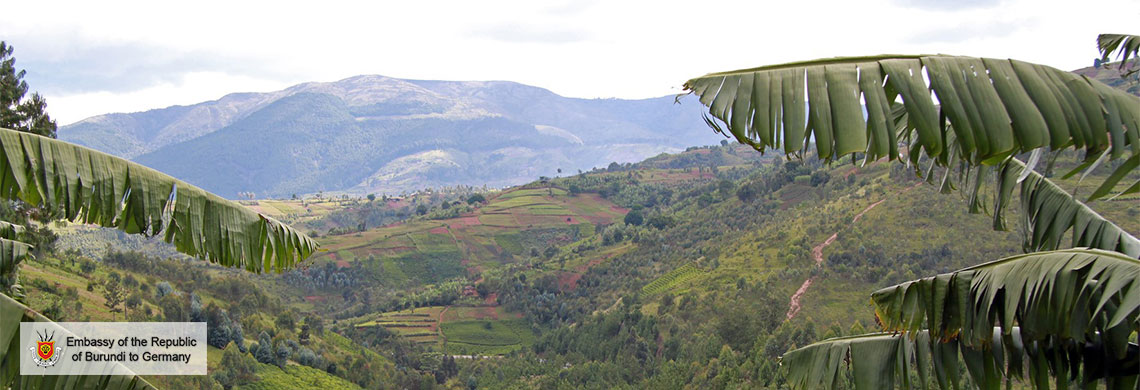
Often called “the heart of Africa,” Burundi covers an area of 27,834 square kilometers and lies between 2º30’ and 4º30’ latitude South and between 28º50’ and 30º53’30’ longitude East. Bounded to the North by Rwanda, to the West by Democratic Republic of Congo, and to the East and South by Tanzania, Burundi is part of East-Central Africa. It is part of the region of great lakes and rift valleys, which extends through Central Africa from the Red Sea to Lake Malawi through Ethiopia.
Burundi is a landlocked country
Distances as the crow flies:
From Bujumbura to the Indian ocean Port :1,100 km
From Bujumbura to the Atlantic ocean Port: 1,900 km
Surface distances:
Dar-es-Salaam to Kigoma : 1,250 km by rail
Kigoma to Bujumbura: 176 km by navigating: crossing Lake Tanganika
Mombasa to Kampala to Kigali to Bujumbura: 2,200 km.
Topography
Burundi has four topographical zones:
- The Rusizi plain, where the climate is tropical
- The Congo-Nile Ridge, where the climate is mild and temperate; this area includes the great secondary forest of Kibira
- The central plateau, featuring rolling hills
- The depressions of the East and North-East, featuring tree-dotted savanna
Climate
Burundi has a “moderate” tropical climate with average temperatures between 23 and 24ºC. This is a gift from nature to have such an average near the Equatorial area known for its heat and humidity. In Bujumbura city where it is hotter, average temperatures are about 25ºC. The country has two important seasons: the dry season from June to September and the rainy season from February to May. The remaining time is made up of middle seasons- half-dry and half-rainy-with a short rainy season between September and December and a short dry season between January and February. The vegetation is lush and agriculture important.
Hydrology
The originality of Burundi’s hydrography lies in the role played by the Congo Nile Ridge in the division of the catchment basins.There are two basins: The basin of the River Congo, comprising all the rivers to the West of the ridge and the Kumoso, a tributary of the Maragarazi river.The Nile basin, comprising all the tributaries of the Ruvubu and the Kanyaru. With this basin, Burundi can claim to possess the Southernmost source of the Nile river, located near Rutovu commune, where a pyramid was erected in 1938. In addition to Lake Tanganika, there are many inland lakes commonly known as the “bird lakes” in the North-East of the country; among them are lakes Rwihinda, Cohoha, Rweru and Kanzigiri.
History
Historical Background in Brief
1500: Even before the fifteenth century, Burundi was an organized nation, a kingdom with sound political structures and a social organization of its own, since then, the country was ruled by a line of seventeen Kings of four dynasties of Ntare, Mwezi, Mutaga and Mwambutsa.
1890: The German colony was given the official title of “German East African Protectorate (including Burundi, Rwanda, and Tanganyika territory in 1899)
1903: King Mwezi gisabo accepted the German Protectorate by the Treaty of Kiganda
1919: After the 1st world war, Burundi was declared “Occupied territory and placed under the authority of Belgium by the League of Nations
After the second World War, the League of Nations was replaced by the United Nations (UN), Belgium was then obliged to submit regular reports to the U.N. Trusteeship Council
1958: Prince Rwagasore, eldest son of the MWAMI founded the Party of National Unity and Progress (UPRONA)
September 18, 1961: The elections by universal outrage put Prince Louis Rwagasore in Power as Prime Minister
October 13, 1961: Assassination of Prince Louis Rwagasore
July 1st, 1962: Burundi achieved its independence
November 28, 1966: Burundi became a Republic
April 29, 1972: ethnic violence resulting in the killings of several thousand people.
November 1st, 1976: Colonel Jean Baptiste BAGAZA took power and proclaimed the second Republic.
September 3rd, 1987: Major Pierre BUYOYA took charge with army backing and proclaimed the 3rd Republic.
August 1987: In so-called “Ntega-Marangara events” an outbreak of ethnic conflict in the northern localities of Ntega and Marangara resulted in the killings of several hundred people.
Following the uprising, a military intervention responded to the killings by using force to restore order, to stop the widespread of violence over the country and to limit the outflanking movement.
October 4th, 1988: President BUYOYA charged a national commission with studying the question of National Unity.
February 6, 1991: The Charter of National Unity was ratified in referendum.
March 9, 1992: A new constitution legalizing a plural political system in Burundi was ratified in a national referendum.
June 1st, 1993: Presidential elections won by Sahwanya-Frodebu political party of Melchior NDADAYE.
June 29, 1993: Legislative elections won by Sahwanya-Frodebu (Democratic Front of Burundi).
July 10, 1993: Melchior NDADAYE was sworn in as a Burundi’s first democratically elected President.
October 21, 1993: Assassination of President Melchior NDADAYE. The country went through serious crisis with the beginning of the systematic massacres between Hutu and Tutsi factions. Since then, many people from both sides have died.
January 22, 1994: Inauguration of President Cyprien NTARYAMIRA.
April 6, 1994: President Cyprien NTARYAMIRA was killed in plane crash together with President Juvenal Habyalimana of Rwanda.
November 1st, 1994: The “Convention of Government” (Convention de Gouvernement) signed by 13 political parties on 10th September 1994 put in power President Sylvestre NTIBANTUNGANYA from Frodebu with a Prime Minister from UPRONA.
July 25, 1996: As a result of failure of Convention institutions, Major Pierre BUYOYA took again control in coup d’Etat.
August 28, 2000: The peace initiative undertaken by former Tanzanian President Julius Nyerere in March 1996 led to signing of the Arusha Peace and Reconciliation Agreement, with transitional power-sharing arrangement between Pierre BUYOYA’s UPRONA and FRODEBU. The 23 July 2002 Regional Summit named Major Pierre BUYOYA as leader of the first transition government.
April 30, 2003, President Domitien NDAYIZEYE was sworn in as President for the second half of the three-year transitional government inaugurated on 1st November 2001.
October 8, 2003: The transitional Government and the national Council for the Defense of Democracy-Forces for Defense of Democracy (CNDD-FDD), signed the Pretoria Protocol on Political Defense and Security Power sharing. They reaffirm their commitment to the ceasefire agreement between the parties signed in Arusha on 2nd December 2002 as well as the joint Declaration of Agreement addressing the practical implementation of the December 2002 cease fire Agreement, signed in Pretoria on 27 January 2003.
November 23, 2003: The CNDD-FDD is part of the Executive with four ministries including a Minister of State.
February 28th, 2005: Constitutional referendum and adoption by a large majority of burundiese population.
June 3rd, 2005: Local elestions
July 4th, 2005: Parliamentarian elections
July 29th, 2005: Senatorial elections
August 19th, 2005: Presidential elections by the parliament.
August 26th, 2005: President Pierre Nkurunziza was sworn in.
|
Administrative Division
Burundi is divided into 16 provinces including Bujumbura City and 116 communes. Each province is administrated by a Governor and each commune by an Administrator. |
Provinces |
Communes |
Bubanza |
Bubanza, Gihanga, Mpanda, Musigati, Rugazi. |
Bujumbura city |
Buyenzi, Bwiza, Cibitoke, Gihosha, Kamenge, Kanyosha, Kinama, Kinindo, Musaga, Ngagara, Nyakabiga, Rohero, . |
Bujumbura rural |
Isale, Kabezi, Kanyosha, Mubimbi, Mugongo-Manga, Muhuta, Bugarama, Mutambu, Mutimbuzi. |
Bururi |
Burambi, Bururi, Buyengero. Matana, Mugamba, Rumonge, Rutovu, Songa, Vyanda. |
Cankuzo |
Cankuzo, Cendajuru, Gisagara, Kigamba, Mishiha. |
Cibitoke |
Buganda, Bukinanyana, Mabayi, Mugina, Murwi, Rugombo |
Gitega |
Bugendana, Bukirasazi, Buraza, Giheta, Gishubi, Nyarusange, Gitega, Itaba, Makebuko, Mutaho, Ryansoro. |
Karusi |
Bugenyuzi, Buhiga, Gihogazi, Gitaramuka, Mutumba, Nyabikere, Shombo. |
Kayanza |
Butaganzwa, Gatara, Gahombo, Kabarore, Kayanza, Matongo, Muhanga, Muruta, Rango |
Kirundo |
Bugabira, Busoni, Bwambarangwe, Gitobe, Kirundo, Ntega, Vumbi. |
Makamba |
Kayogoro, Kibago, Mabanda, Makamba, Nyanza-Iac, Vugizo. |
Muramvya |
Bukeye, Kiganda, Mbuye, Muramvya, Rutegama. |
Muyinga |
Buhinyuza, Butihinda, Gashoho, Gasorwe, Giteranyi, Muyinga, Mwakiro. |
Mwaro |
Bisoro, Kayokwe, Gisozi, Ndava, Nyabihanga, Rusaka. |
Ngozi |
Busiga, Gahikanwa, Kiremba, Marangara, Mwumba, Ngozi, Nyamurenza, Ruhororo, Tangara. |
Rutana |
Bukemba, Giharo, Gitanga, Mpinga-kayove, Musongati, Rutana. |
Ruyigi |
Butaganzwa, Butezi, Bweru, Gisuru, Kinyinya, Nyabitsinda, Ruyigi. |
Population
The population of Burundi is currently estimated at around 6,9 million in 2001. It has the highest population density of all Africa-150 inhabitants per square kilometer. The population is however spread very unevenly: the central plateau and the highlands are the most heavily populated and here the density is 295 inhabitants per square kilometer. |
Population statistics (2001 estimation) |
| Population |
6,9 million |
| Growth rate |
1,9% |
| Fertility rate |
5,9 children born/women |
| Birth rate |
40/1,000 |
| Death rate |
18/1,000 |
| Infant mortality |
114/1,000 |
| Life expectancy |
41,8 years |
The cultural and linguistic uniformity of the country is one of the most striking features. Kirundi, the national language, is spoken by everyone, while French is the second language and the one generally used by government services.
Ethnic groups
There are 3 social groups or groups improperly called “ethnic groups”: Hutu (85%), Tutsi (14%) and Twa (1%).
Unlike real ethnic groups, Burundians have spoken one and the same unique language-Kirundi for a long time. They share the same values and live in the same villages. They all live on agriculture combined with livestock. There is no historical or identity reference which distinguishes them. Nevertheless, the Twa are not well integrated into the social order.
Despite the cultural, territorial and administrative unity of the Burundian people, their recent history has been characterized by tribal wars between communities, the height of which was reached in 1972 and 1993. But, one should not be mistaken because the great majority of the population (all the communities together) continue to live together as before on the same hills, they go to church, school, markets, bars and fetch water from the same springs. |
Religion
|
The majority of Burundians are christian (Roman Catholic 62%, Protestant 5%). The rest are Muslim (10%) and indigenous beliefs(23%) |
Art and Culture
A. Language
Situated in the heart of Africa, Burundi is one of the very few African countries possessing linguistic homogeneity. Its people all speak the same national language, Kirundi, the medium of expression of Burundi’s centuries-old cultural heritage. French is the first foreign language, which became an administrative language. English is progressively getting important because of the opening of the country to the business world and the international market. Swahili, a trade language above all, is spoken in the cities and along Tanganika Lake.
B. Poetry and Popular Songs
The culture of Burundi is based mainly on song, poetry, the dance, stories and legends. Poetry is recited at late-night social gatherings; it is centered mostly around pastoral themes. Rich and varied popular songs are rendered at family and communal fêtes and festivals, and are sung during work in the fields.
The shepherds have their own pastoral songs which they sing at the end of the day when leading the animals back from the pastures; and in the home the elders tell the young generation stories and legends relating the life of their ancestors.
C. Arts and handicrafts
The art of Burundi is extremely varied. It is characterized by decorative motifs and geometrical patterns in which the artist’s initial inspiration predominates. This highly stylized art possesses a harmony derived from asymmetry and contrasts that do not clash. It finds expression in wrought iron, wickerwork, pottery, sculpture and bas-reliefs. |
D. Dancers and drummers
Burundi also boasts a wide variety of popular dances each region having its own speciality.
|
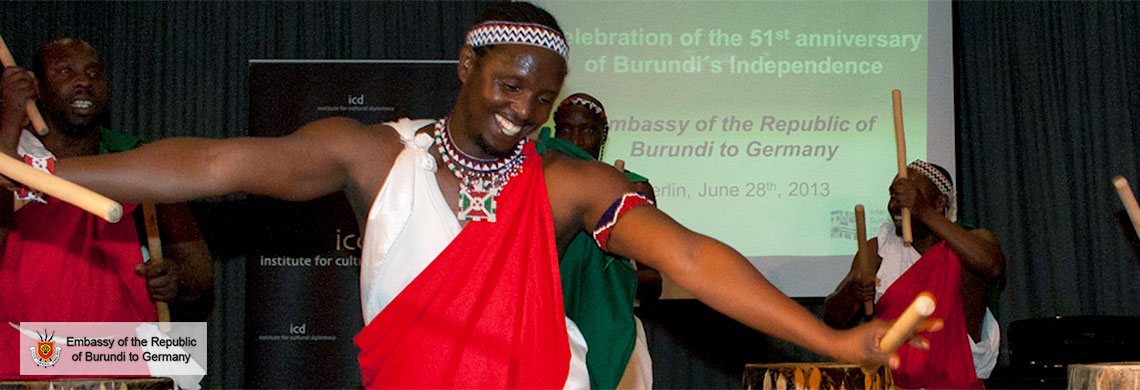
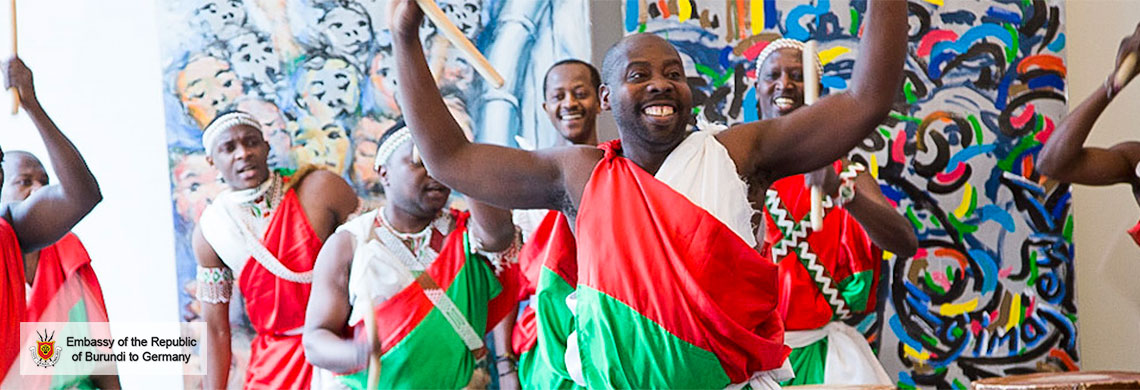
Gitega, in the centre, has its traditional dancers, named "Batimbo," who perform to the accompaniment of tambourines. These performers have already taken part in international festivals in Washington, Montreal, Berlin, Algiers, Dakar, Munich, Rennes, Tokyo and elsewhere, and have been enthusiastically acclaimed. |
|
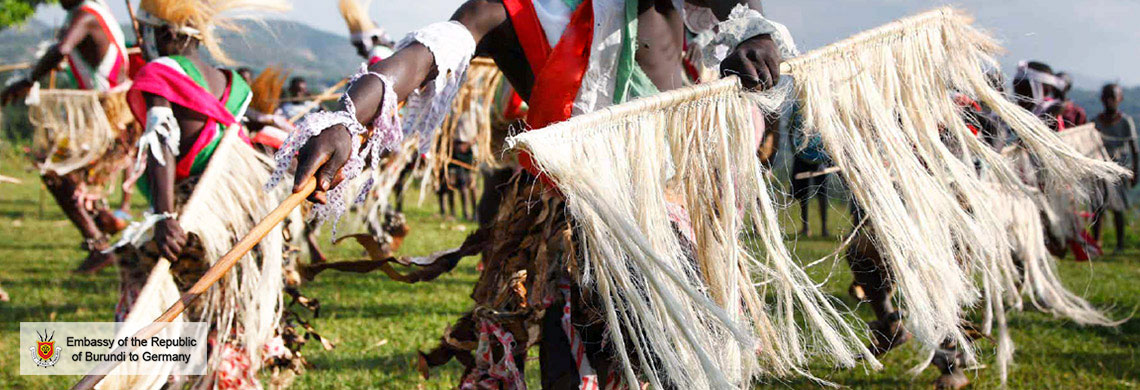
Kirundo, located in the north is also the ideal spot for people who love Africa, with its traditional ways and ancestral rhythms, as it is for those who are seeking for silence and peace. Not far from Kirundo lie Kabanga and Mukenke, the cradle of the world famous “ Intore,” troops and dancer-drummers who excel at a surprising and fascinating type of dance. It is also one of the few dance forms in the world where the dancers set the beat for the musicians instead of vice versa. |
| There are also the Inamukosi and Intore dancers of Muyinga in the North and the Agasimbo dancers of Makamba in the South. |
Burundi Democratic Process
The general election by universal election held in June 1993 resulted in victory of the Democratic Front party of Burundi (FRODEBU). Unfortunately, the Burundi first democratically elected president Melchior NDADAYE was assassinated in October 1993 after only four months in office. Since then, some Burundians have perished in widespread, often intense ethnic violence between Hutu and Tutsi factions. Hundreds of thousands have been internally displaced or have become refugees in neighboring countries.
Burundi Peace Process Negotiations took place for four years in Arusha, Tanzania and Pretoria, South Africa, between all the Burundi parties and political movements in an effort to put an end to violence and find a new peace formula for all. The peace initiative led to signing of the Arusha Peace and reconciliation agreement on 28 of August 2000 which designed a transitional power sharing arrangement between the signatories to this agreement.
The negotians between the transitional government of Burundi and the National Council for the Defense of Democracy-Forces for Defense of Democracy (CNND-FDD) have resulted to the signing the Pretoria Protocol on Political, Defence and Security Power Sharing in Burundi on October 8, 2003.
Burundi was ruled since the beginning of the internal peace process in 1998 by an internal partnership for peace made up of two transitional institutions: the Government and the National Assembly. This partnership was in fact a Government of national coalition.
The Chief of State and Head of Government, President Domitien Ndayizeye (FRODEBU) sworn in as President for the second half of the three-year transition government (April 30, 2003 - August 19, 2005). He had a Vice-President, Mr. Alphonse Kadege (UPRONA), from a party and a social group different from those of the President of the Republic.
The end of the four years peace process was marked by the parliement and presidential elections that took place respectively on July 04, 2005 and August 19, 2005 as well as the formation of a new government. |
New Government of the Republic of Burundi
| Président de la République du Burundi |
S.E. M. Pierre NKURUNZIZA |
| Premier Vice-Président |
S.E. Dr. Yves SAHINGUVU |
| Deuxième Vice-Président |
S.E. M. Gabriel NTISEZERAMA |
| Ministre des Relations Extérieures et de la Coopération Internationale |
M. Augustin NSANZE |
| Ministre de l’Intérieur |
M. Edouard NDUWIMANA |
| Ministre de la Sécurité Publique, Commissaire de Police |
M. Alain Guillaume BUNYONI |
| Ministre de la Défense Nationale et des Anciens Combattants |
Lieutenant Général
Germain NIYOYANKANA |
| Ministre du Plan et de la Reconstruction |
M. Tabu Abdallah MANIRAKIZA |
| Ministre des Finances |
Mme. Clotilde NIZIGAMA |
| Ministre à la Présidence chargé de la Bonne Gouvernance, de la Privatisation |
M. Martin NIVYABANDI |
| Ministre de la l’Agriculture et de l’Elevage |
Ing. Ferdinand NDERAGAKURA |
| Ministre de l’Enseignement Supérieur et de la Recherche Scientifique |
Dr. Ing. Saidi KIBEYA |
| Ministre de l’Enseignement Primaire et Secondaire |
M. Ernest MBERAMIHETO |
| Ministre de la Santé Publique |
Dr. Emmanuel GIKORO |
| Ministre de la Justice et Garde des Sceaux |
M. Jean Bosco NDIKUMANA |
| Ministre de l’Energie et des Mines |
M. Samuel NDAYIRAGIJE |
| Ministre de l’Information, de la Communication, des Relations avec le Parlement |
M. Vénérand BAKEVYUMUSAYA |
| Ministre du commerce, de l’Industrie et du Tourisme |
Mme Euphrasie BIGIRIMANA |
| Ministre de l’Eau, de l’Environnement, de l’Aménagement du Territoire et de l’Urbanisme |
Ing. Agronome Déogratias NDUWIMANA |
| Ministre des Transports, Postes et Télécommunications |
M. Philippe NJONI |
| Ministre de la Fonction Publique, du Travail et de la Sécurité Sociale |
Mme Annonciata SENDAZIRASA |
| Ministre de la Jeunesse, des Sports et de la Culture |
M. Jean Jacques NYENIMIGABO |
| Ministre de la Solidarité Nationale, du Rapatriement des Réfugiés et de la Réintégration Sociale |
Hon. Immaculée NAHAYO |
| Ministre de la Décentralisation et du Développement Communal |
M. Pierre MUPIRA |
| Ministre des Travaux Publics et de l’Equipement |
Ing. Anatole KANYENKIKO |
| Ministre des Droits de la Personne Humaine et du Genre |
----------------- |
| Ministre de la Lutte contre le Sida |
Mme Spéciose BARANSATA |
| Ministre des Affaires de la Communauté Est Africaine |
Mme Hafsa MOSSI |
Ministre de l’Enseignement des Métiers, de la Formation Professionnelle et de l’Alphabétisation |
Dr. Rose GAHIRU |
| Secrétaire Général et Porte Parole du Gouvernement |
M. Philippe NZOBONARIBA |
Other National Institutions
Coming soon!
Burundi Education System
Institution Types & Credentials
Types of Higher Education Institutions:
Université (University)
Institut Supérieur (Higher Institute)
Higher Education Credentials:
Diplôme d'Etat
Technicien
Candidature
Diplôme
Ingénieur technicien
Diplôme d'Ingénieur
Licence
Doctorat en Médecine
Diplôme d'Etudes approfondies (DEA)
Diplôme de Spécialité
Doctorat de Spécialité (3e Cycle)
Structure of Education System
1. Kindergarten
Length of program : 3 years
Age level: 3 to 6
Type of school providing this education: Private schools
Structure of school system:
2. Primary
Type of school providing this education: Ecole primaire
Length of program in years : 6
Age level from: 6 to 12
Certificate/diploma awarded: Certificat de Fin d'Etudes primaires (Primary school leaving certificate)
3. Lower Secondary
Type of school providing this education: Collège
Length of program in years: 4
Age level from: 12 to 16
Certificate/diploma awarded: Certificat du Tronc commun (Lower Secondary Level Certificate)
4. Technical Secondary
Type of school providing this education: Technical Secondary School (Lower Level)
Length of program in years: 5
Age level from: 12 to 17
Certificate/diploma awarded: Technicien (Technician Diploma A3 for Lower Level)
5. Technical Secondary
Type of school providing this education: Technical Secondary School (Upper Level)
Length of program in years: 7
Age level from: 12 to 19
Certificate/diploma awarded: Technicien (Technician Diploma A3 for Upper Level)
6. Upper Secondary School
Type of school providing this education: Lycée
Length of program in years: 3
Age level from : 16 to 19
Certificate/diploma awarded: Diplome d'Etat
School Education
Primary education:
Primary education lasts for six years leading to the Certificat d'Etudes primaires (elementary education).
Secondary education:
Secondary education is divided into lower and upper secondary education. Lower secondary education is available to those who pass the National Entrance Examination and lasts four years. A national test is imposed on all those who complete lower secondary education. Their records are submitted to a National Orientation Commission. Schooling at upper secondary level lasts three years after lower education and leads to the Diplôme d'Etat, which gives access to higher education. Technical secondary education lasts seven years. A Diplôme A2 sanctions success in technical studies and a Diplôme A3 is conferred after a cycle of studies lasting five years following upon primary education. Higher education:
Higher education: is mainly provided by the Université du Burundi. It is largely financed by the State and enjoys administrative and management autonomy. It is administered by a Rector appointed by the President of the Republic for four years. Policy-making is the responsibility of a Governing Board appointed by the President of the Republic and representing the major spheres of activity concerning higher education development. Four private universities have been created recently.
Main laws/decrees governing higher education
Decree n° 100/181 of 1988 concerning the Ministry of Education
Decree n°1/025 of 1989 concerning the reorganization of educational system
Academic year: October to June
Long vacation from: July 1st to October 1st
Languages of instruction: French
Stages of studies: Non-university level post-secondary studies (technical/vocational type)
Non-university level: Several Ministries organise higher level courses.
University level studies
University level first stage: Candidature
The first stage of study in preparation for the Licence lasts for two years and leads to the Candidature.
University level second stage: Licence
A further two year-study beyond the Candidature leads to the Licence. In Medicine, the professional title of Docteur en Médecine is awarded after a further four years of study following the Candidature. In Civil and Agronomic Engineering, courses last for five years and lead to the award of the professional title of Ingénieur. The Diplôme d'Ingénieur Technicien is conferred after three or four years' training in the technical institutes.
University level third stage: Diplôme d'Etudes Approfondies (DEA) or Doctorat de 3ème Cycle
A Diplôme d'Etudes approfondies is conferred in subjects such as Computing, Physics and Agricultural Planning following the Licence or the Diplôme d'Ingénieur. In Medicine, there are two stages which lead to a professional Doctorat in Medicine after six years and a Special Doctorat after five more years of study and the presentation of a major thesis in Clinical Biology, Paediatrics, Surgery, Gynaecology and Internal Medicine. The University also awards a Doctorat de 3ème Cycle.
Teacher Education
Training of pre-primary and primary/basic school teachers
Primary school teachers are trained in "lycées pédagogiques" which offer studies divided into two cycles of two years each. In-service training of primary teachers is a regular activity of the Office for Rural Education (BER), a curriculum development agency.
Training of secondary school teachers
Secondary school teachers are trained at the University of Burundi from which they graduate after four years in the various specialities. Some teachers specifically trained for secondary education, are also trained at the Pedagogical Institute for three to five years. They may also be trained in "Ecoles normales supérieures."
Non-traditional studies
Other forms of non-formal higher education
Non-formal studies consist of in-service courses offered by the Institut supérieur de Gestion d'Entreprise for management professionals. There are two levels of training: short cycle training for holders of the Diplôme d'Etat and long cycle training for holders of degrees in economics or their equivalent. Evening courses are also organized in computer sciences.
National Bodies
Administration & Coordination
Responsible authorities:
Ministry of National Education (Ministère de l'Education Nationale)
Head: Prosper Mpawenayo, Minister
PO Box 1990
Bujumbura, Burundi
Tel: 257(22) 5112/5514
Fax: 257(22) 6839
Role of governing body: Central Administration and Coordination
Admissions to Higher Education
Admission to non University Higher Education Studies
Name of secondary school credential required: Diplôme d'Etat
Minimum score/requirement: Varies according to year
Alternatives to credentials: State examination
Admission to University-level studies
Name of secondary school credential required: Diplôme d'Etat
Minimum score/requirement: Varies according to year
Alternatives to credentials: A State Examination is required for the Higher Technical Institute.
Foreign students admission
Admission requirements:
- Foreign students must have followed seven years of general education (High school diploma) or hold a technician diploma
- They must hold a visa and a residence permit
- They must have a good knowledge of French language
- They must apply to the national body for entry to the University through the National Commission of Orientation to Higher Education at following address:
PO Box 1990
Bujumbura, Burundi
Tel: 257(22) 4407
Fax: 257(22) 8477
Recognition of Studies & Qualifications
Studies pursued in foreign countries (bodies dealing with recognition of foreign credentials): National Commission for Diploma Equivalance , School Titles and Universities
Head: Aaron Barutwanayo
PO Box 1990
Bujumbura, Burundi
Tel: 257(22) 5112/5514
Special provisions for recognition:
For access to university level studies: The holder of a foreign credential must submit to the "Commission d'Equivalence des Titres et Diplômes universitaires" the following data: curriculum vitae/resume specifying the duration of the training abroad; total number of hours of all the training modules; contents of training programmes; methods of assessment, and certified copy of the original credential.
For access to advanced studies and research: Same as above.
Multilateral agreements concerning recognition of foreign studies
Name of agreement: Convention on the Recognition of Studies, Certificates, Diplomas, Degrees and Other Academic Qualifications in the African States Year of signature: 1981 References to further information on foreign student admissions and recognition of studies
Title: Vademecum de l'Etudiant
Publisher: Université du Burundi
Student Life
Main Student Services at National Level:
Régie des Oeuvres universitaires (ROU)
PO Box 1644
Bujumbura, Burundi
Category of services provided: Social and welfare services
Secrétariat du Service académique de l'Université du Burundi PO Box 1550
Bujumbura,Burundi
Tel: 257(22) 2059 and 257(22) 3468
Fax: 257(22) 3288
Category of services provided: Academic and career counselling services
National Student Associations and Unions and Association des Etudiants RUMURI (ASSER)
PO Box 1644
Bujumbura, Burundi
Special student travel fares:
By air: Yes
Student expenses and financial aid
Bureau des Bourses d'Etudes et de Stages (BBES)
PO Box 1990
Bujumbura, Burundi
Tel: 257(22) 5112 and 257(22) 5514
Fax: 257(22) 6839
Category of services provided:information on student financial aid
Grading System
A. Secondary School
Full Description 0-100%:
- 90-100%: Excellent
- 80-89%: La plus grande distinction
- 70-79%: Grande distinction
- 60-69%: Distinction
- 50-59%: Satisfaction
- below : 50% fail
Highest on scale: 100%
Pass/fail level: 50%
Lowest on scale: 0%
B. Higher Education Institutions
Full Description 0%-100%:
- 90-100%: Excellent
- 80-89%: La plus grande distinction
- 70-79%: Grande distinction
- 60-69%: Distinction
- 50-59%: Satisfaction
- below : 50% fail
Highest on scale: 100%
Pass/fail level: 50%
Lowest on scale: 0%
|
| Source: UNESCO Web site and Ministry of National Education, Department of Higher Education, Bujumbura, Burundi 2001 |
Burundi Important Dates
| January 1 |
New Year's Day |
| February 5 |
National Unity Day |
| May 1 |
Labor Day |
| Thursday the 40th day after Easter |
Ascension Day |
| July 1 |
Independence Day |
| August 15 |
Assumption |
| October 13 |
Prince Louis Rwagasore's Day |
| October 21 |
President Melchior Ndadaye's Day |
| November 1 |
All Saints' Day |
| December 25 |
Christmas Day |
| |
The end of Ramadan (Aid El Fitr) |
| |
Aid El Kebir |
|